5 Signs Your Wisdom Teeth Need to Come Out
Wisdom teeth — your third molars — are the last teeth to emerge, usually appearing in your late teens or early twenties. For many patients visiting our oral surgery practice in Clinton, MD, these teeth never fully erupt, grow at awkward angles, or simply don’t have enough room to develop properly. Left unaddressed, they can silently cause serious problems.
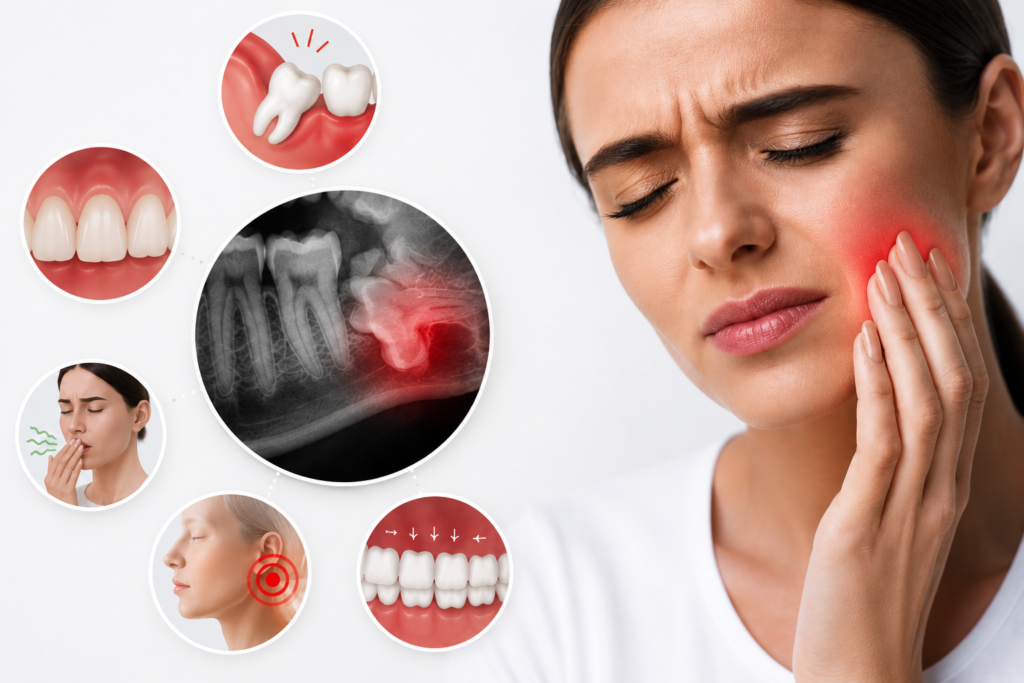
The challenge? Many people don’t realize their wisdom teeth are causing issues until the damage is already done. That’s why knowing the warning signs matters. Below are five clear signs that your wisdom teeth may need to come out — and what to do if you recognize any of them.
Pain or Pressure at the Back of Your Mouth
One of the earliest and most telling signs of problematic wisdom teeth is a dull, persistent ache at the very back of your jaw — sometimes radiating toward your ear or temples. This pain is often caused by impacted wisdom teeth pushing against surrounding bone and neighboring molars as they try to erupt.
Many patients from Hyattsville, Clinton, and surrounding Prince George’s County communities come to us describing this as a “pressure” sensation that comes and goes — often worsening when chewing or opening the mouth wide. Don’t dismiss this as normal growing pain. If it persists beyond a few days, it deserves evaluation.
Swollen, Tender, or Bleeding Gums Near Your Back Teeth
When a wisdom tooth partially erupts through the gum, it creates a flap of gum tissue called a pericoronal flap — a breeding ground for bacteria. The result is pericoronitis, an infection of the soft tissue around the tooth that causes swollen, red, painful gums and sometimes a bad taste or odor in the mouth.
If your gums near your back molars look puffy, feel sore when you press on them, or bleed when you brush — even gently — that’s your body signaling that something isn’t right. Left untreated, pericoronitis can spread to the throat, jaw, or neck.
Crowding, Shifting, or Changes in Your Bite
Even if your wisdom teeth haven’t broken through the gum, the pressure they exert as they push forward can shift your other teeth. If you’ve noticed your teeth suddenly feel more crowded, your bite feels different, or teeth that were previously straight now seem to be moving — impacted wisdom teeth could be the cause.
This is a particularly important concern for patients who have previously had orthodontic treatment. Wisdom tooth pressure can undo years of orthodontic work, pushing teeth out of alignment over time. A simple panoramic X-ray can quickly reveal whether your wisdom teeth are the culprit.
Persistent Bad Breath or Unpleasant Taste in Your Mouth
If you brush and floss consistently but still notice persistent bad breath or a strange taste — especially at the back of your mouth — partially erupted or impacted wisdom teeth may be harboring bacteria that your toothbrush simply can’t reach.
The difficult-to-clean pockets around partially erupted wisdom teeth collect food particles and bacteria, leading to decay in both the wisdom tooth and the molar in front of it. In some cases, patients don’t realize their second molar is being damaged until the cavity is severe.
Cysts, Cavities, or Abnormalities Detected on X-Rays
Some of the most serious wisdom tooth complications have no outward symptoms — they’re only visible on imaging. Impacted wisdom teeth can develop cysts (fluid-filled sacs) around their crowns that silently destroy bone, damage adjacent teeth, and in rare cases, lead to tumor formation.
Routine panoramic X-rays taken by your general dentist in the Hyattsville or Clinton, Maryland area can detect impacted teeth, early cyst formation, and decay on neighboring molars — all before you feel a thing. If your dentist has referred you to an oral surgeon after reviewing your X-rays, don’t delay the evaluation.
Why Early Removal Is Usually Easier
Timing matters significantly when it comes to wisdom tooth removal. Younger patients — typically those between 17 and 25 — tend to heal faster because the roots are not yet fully formed and the surrounding bone is more pliable. Waiting until wisdom teeth are causing significant damage often means a more complex surgery and longer recovery.
At Saxira Oral Surgery in Clinton, MD, we use 3D cone beam CT imaging to evaluate wisdom teeth with precision — allowing our provider to plan each extraction with a clear picture of root anatomy, nerve proximity, and bone density before any surgery begins.
Not Sure About Your Wisdom Teeth?
Book your personalized consultation today.
Designed around patient comfort and surgical excellence, our practice delivers refined care with results you can trust.